Got this camera?
Sell it with us.
Free appraisal in 24 h, payment in 48 h and free shipping. We inspect it, refurbish it and give it a second life.
Inspected at 28 points by our technicians. Every unit is unique. More details
Subscribe and save on your order
Get a discount code by email.
Thanks for subscribing.
Use the code at checkout:
CAMERAMARKET10
Protect your purchase for longer.
Your camera ships with 6 months of coverage included. Extend it if you want professional photographer peace of mind.
Units sold for parts do not qualify for extended warranty.
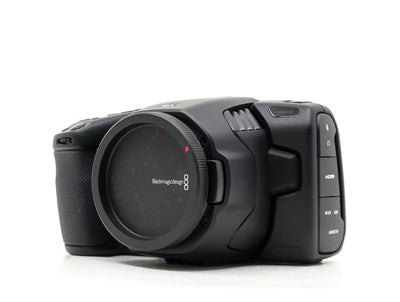
View warranty terms and conditionsThe Blackmagic Pocket Cinema Camera 4K (BMPCC 4K, model CINECAMPOCHDMFT4K) was announced at NAB 2018 and hit the market at the end of that year with a launch price of $1,295 for the body. With it, Blackmagic democratized cinema-style video: it put 12-bit RAW and ProRes, up to 13 stops of dynamic range, and a full DaVinci Resolve Studio license into the hands of budget-conscious creators, taking on the Panasonic GH5S for considerably less money.
It is not a stills camera or a lightweight "run-and-gun" compact: it is a shooting tool. It mounts a Four Thirds sensor (18.96 × 10.00 mm) with an interchangeable Micro Four Thirds mount, dual native ISO (400 and 3200), and records DCI 4K up to 60 fps and 1080p up to 120 fps. Its large 5" touchscreen, mini-XLR input with 48V phantom power, and full-size HDMI output make it a very capable platform for shooting with a tripod or gimbal and then grading in DaVinci.
In return, it demands a serious post-production workflow, a capable computer, and fast cards. It is honest with those who seek it for what it is: cinema image quality at a price that remains hard to match on the used market.

Read more Read less
The Blackmagic Design Pocket Cinema Camera 4K features a 4/3" sensor for capturing up to 4096 x 2160 DCI 4K images at rates up to 60 fps in a variety of codecs including CinemaDNG Raw/Raw 3:1/Raw 4:1, and various ProRes 422 options. Slow-motion rates up to 120 fps are available in cropped Full HD. Its Micro Four Thirds lens mount accommodates The original, lightweight Pocket Cinema Camera lenses, and can be used with PL, C, EF, and other lenses with the use of separately available adapters. A dual-native ISO up to 25,600 is featured for low-light capture, and 13 stops of dynamic range provide rich HDR images.
- Standard 6-month warranty
- Blackmagic Design 12V AC Adapter
- Blackmagic Design Battery Door
- Blackmagic Design Micro Four Thirds Fit Front Lens Cap
- Third Party Baseplate
- Third-party LP-E6 Battery
- Third Party Side Handle
- Third Party V Mount Plate
Is it suitable for taking photos or simple vlogs?
That is not its function. The BMPCC 4K is a digital cinema camera designed for shooting video with a post-production workflow (RAW/ProRes and grading in DaVinci). It has no in-body stabilization or reliable autofocus, so for handheld vlogging or casual photos it is not the right tool; it shines on a tripod or gimbal.
How long does the battery really last?
In real use, it is around 30-40 minutes per battery (Canon LP-E6 type). Additionally, the charge indicator is inaccurate and the camera can shut down while still showing 30-40%. The sensible thing is to buy several original Canon batteries (third-party ones give even less reliable readings) or the official grip.
What video quality does it offer?
It records DCI 4K (4096×2160) up to 60 fps and 1080p up to 120 fps, in 10-bit ProRes and 12-bit RAW, with up to 13 stops of dynamic range and dual native ISO. That is the model's big selling point: cinema-level image far above its price. However, RAW generates huge files that require fast cards (CFast/SSD) and a good editing computer.
Is it good for starting in cinema video?
It can be if you come to learn grading and RAW workflow, since it includes DaVinci Resolve Studio. But it has a learning curve: without IBIS, without a viewfinder, with weak autofocus and short battery life, it rewards those who already work with a tripod, external monitor, and post-production. As a first camera for stable, hassle-free video, there are more comfortable options.
What should I check when buying a used BMPCC 4K?
Key points: that the battery door closes properly (it is a weak point by design), absence of dead or hot pixels (record a clip with the lens cap on at high ISO), that both slots (CFast and SD) and USB-C recording work, that the 3.5mm jack input gives audio, and that the fan starts without overheating. Also confirm that the firmware is updated to Blackmagic RAW.
How do I distinguish it from the BMPCC 6K?
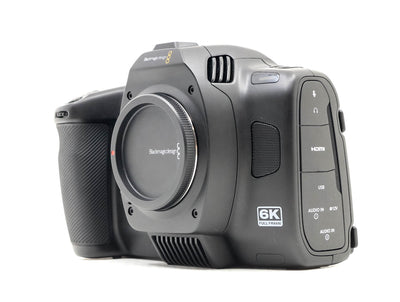
They are easy to confuse. The 4K mounts a Four Thirds sensor and MFT mount, while the 6K uses a Super35 sensor and EF mount. Make sure the unit is really the 4K and that the accessories and mount correspond to that model.
What about the DaVinci Resolve Studio license?
The camera was sold with a full DaVinci Resolve Studio license (approx. $300 value). In the used market, it only adds value if the code has not been consumed or registered, so it is worth asking about its status before buying.
To complete it, take a look at spare batteries, memory cards, or cases.
Full condition scale
Each unit is inspected at 28 points and graded honestly. Here's how we translate each level so you know what to expect:
Barely any signs of use. Almost flawless aesthetics and perfect operation.
Light marks from normal use. Optically clean and fully functional.
Visible signs of use (scuffs, marks, brassing). Works perfectly.
Not guaranteed for use: sold for parts or repair.
Why buy used?
Depreciation is already absorbed: the same gear for much less than new.
Many classics and discontinued gems only exist today on the used market.
28-point inspection and 6-month warranty included on every unit.
Extending the life of a camera avoids manufacturing and transporting a new one.