Got this camera?
Sell it with us.
Free appraisal in 24 h, payment in 48 h and free shipping. We inspect it, refurbish it and give it a second life.
Inspected at 28 points by our technicians. Every unit is unique. More details
Subscribe and save on your order
Get a discount code by email.
Thanks for subscribing.
Use the code at checkout:
CAMERAMARKET10
Protect your purchase for longer.
Your camera ships with 6 months of coverage included. Extend it if you want professional photographer peace of mind.
Units sold for parts do not qualify for extended warranty.
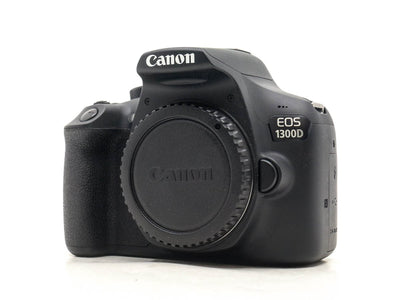
View warranty terms and conditionsThe Canon EOS 2000D is an entry-level digital SLR (DSLR) announced in February 2018. Depending on the region, you will find the same body under other names: Rebel T7 in America, Kiss X90 in Japan, and 1500D in Southeast Asia. If you see any of these, it is exactly this camera.
Its place is clear: the first DSLR for those making the leap from a mobile phone, a beginner on a tight budget, or someone looking for a cheap second camera to learn with. It mounts an APS-C CMOS sensor of 24.1 MP shared with higher-end Canon models, so image quality in stills at low to medium ISO is notably good for its category, with a real optical viewfinder and the usual Canon ergonomics.
It is honest to say what it is not designed for. The DIGIC 4+ processor was already old at its launch: burst shooting stays at 3 fps, autofocus has only 9 points (one cross-type), and video tops out at Full HD 1080p at 30p, without 4K. The screen is fixed and non-touch. It is a camera for learning photography with a huge park of used and affordable EF/EF-S lenses behind it, not a tool for video, sports, or wildlife.

Read more Read less
The Canon EOS 2000D is an entry-level DSLR designed for those starting out in photography with an interchangeable lens camera. It offers a balance between ease of use and image quality, making it a popular choice for learning the fundamentals of exposure and manual focus.
Key Features
- APS-C format CMOS sensor with approximately 24.1 megapixels of resolution.
- Canon EF-S mount, compatible with the full range of EF and EF-S lenses.
- Full HD (1080p) video recording capability at 30 fps.
- Released in 2018, it represents an affordable upgrade within Canon's entry-level lineup.
Ideal for
Perfect for hobbyists looking for their first DSLR, photography students, or users who want a lightweight and simple setup for daily use without advanced technical complications.
Condition
Second-hand product inspected by Camera Market. Includes a standard 6-month warranty and 24-48h shipping from Barcelona.
What lenses are compatible with the Canon EOS 2000D?
It uses the Canon EF and EF-S mount, so it accepts all Canon EF (full frame) and EF-S (designed for APS-C) lenses, as well as third-party optics with EF/EF-S mount like Sigma, Tamron, or Yongnuo. It does not directly mount RF or EF-M lenses. You can see the catalog at Canon EF mount lenses. Remember the 1.6x crop factor (a 50mm frames like an ~80mm equivalent).
Does it record 4K video? Is it good for vlogging?
It does not record 4K. The maximum is Full HD 1080p at 30p (and 720p at 50/60p). Additionally, it has no continuous AF (servo) in video and AF in Live View is slow, and the screen is fixed and non-touch, so you cannot see yourself while recording. For video or vlogging it is not the best option; a 200D/250D or a basic mirrorless with an articulating screen and Dual Pixel AF performs much better.
Is it good for a beginner?
Yes, it is precisely its audience. 24 MP sensor with good image quality, real optical viewfinder, simple Canon ergonomics, and a huge park of cheap EF/EF-S lenses to grow with. It is light and easy to learn. It only makes sense to buy it used if the price is clearly low, because for a little more there are models with better autofocus and articulating touchscreen.
What battery does it use and how much autonomy does it have?
It uses the LP-E10 (Li-Ion, 860 mAh), shared with the Canon T3/T5/T6. The CIPA autonomy is around 500 shots with the viewfinder (drops significantly in Live View); it is an indicative value. They are old and cheap batteries: in a used unit it is worth checking that it holds up and considering a spare. Also verify that it includes the LC-E10 charger.
What should I check when buying it second-hand?
Ask for the shutter count: the shutter is the key consumable. Canon does not publish an official lifespan figure, but the indicative reference for entry-level is around 100,000 actuations; the lower, the better. Check the sensor condition by taking a photo of a white wall or sky at f/16-f/22 to detect dust or spots, and confirm what lens it comes with (see next question), the battery, and accessories.
What kit lens does it come with and which is better?
It usually comes with the EF-S 18-55mm f/3.5-5.6 IS II (with stabilization, the best option) or with the more basic 18-55 III/DC without IS. Confirm which one before buying, because the stabilized version makes a difference handheld. Also check that it includes caps, strap, charger, and original battery.
Does it have stabilization and wireless connectivity?
It does not have in-body stabilization (IBIS): stabilization depends on the lens (IS versions). For connectivity it offers Wi-Fi + NFC with the Canon Camera Connect app for remote control and photo transfer. It does not have Bluetooth.
To complete it, take a look at spare batteries, memory cards, or camera cases.
Full condition scale
Each unit is inspected at 28 points and graded honestly. Here's how we translate each level so you know what to expect:
Barely any signs of use. Almost flawless aesthetics and perfect operation.
Light marks from normal use. Optically clean and fully functional.
Visible signs of use (scuffs, marks, brassing). Works perfectly.
Not guaranteed for use: sold for parts or repair.
Why buy used?
Depreciation is already absorbed: the same gear for much less than new.
Many classics and discontinued gems only exist today on the used market.
28-point inspection and 6-month warranty included on every unit.
Extending the life of a camera avoids manufacturing and transporting a new one.