Got this camera?
Sell it with us.
Free appraisal in 24 h, payment in 48 h and free shipping. We inspect it, refurbish it and give it a second life.
Inspected at 28 points by our technicians. Every unit is unique. More details
Subscribe and save on your order
Get a discount code by email.
Thanks for subscribing.
Use the code at checkout:
CAMERAMARKET10
Protect your purchase for longer.
Your camera ships with 6 months of coverage included. Extend it if you want professional photographer peace of mind.
Units sold for parts do not qualify for extended warranty.
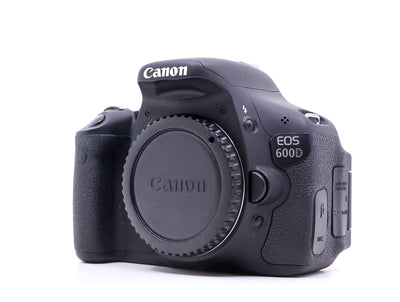
View warranty terms and conditionsThe Canon EOS 700D (Rebel T5i in America, Kiss X7i in Japan) was announced in March 2013 as Canon's entry-level high-end DSLR: the top step before jumping to more serious models. It arrived just nine months after the 650D, which it closely resembles, and its great success was popularizing an articulated touchscreen that is still a pleasure to use today.
It mounts an 18-megapixel APS-C CMOS sensor with a DIGIC 5 processor, shoots 5 fps bursts, and records Full HD 1080p video. It's a camera designed for those starting in reflex photography: learning with interchangeable lenses, family trips, portraits, landscapes, and home video with silent focus if you use STM lenses. The vari-angle screen and full touch control make it ideal for shooting at ground level, overhead, or in first person.
Honestly, in 2013 it was already a very light update, and its AF in video is jerky compared to mirrorless cameras. But for learning fundamentals, with a catalog of very cheap second-hand EF/EF-S lenses, it remains a sensible and very easy-to-live-with reflex entry point.

Read more Read less
The Canon EOS 700D is an APS-C format digital SLR, launched in 2013, positioned as a versatile option for photography enthusiasts seeking a balance between image quality and ease of use. Its intuitive design and reliable performance make it a suitable camera for learning the fundamentals of photography as well as capturing everyday images with confidence.
Key Features
- APS-C format CMOS sensor with approximately 18 megapixels.
- Canon EF-S mount, compatible with the full range of EF and EF-S lenses.
- Full HD (1080p) video recording capability at 30 fps.
- 3-inch vari-angle touchscreen, useful for framing at different angles.
- 9-point hybrid autofocus system, with one cross-type center point.
Ideal for
This camera is designed for beginner or enthusiast photographers looking to make the leap from a compact to a DSLR without complications. It is also a great choice for those seeking a lightweight and manageable setup for travel or family photography.
Condition
Second-hand product inspected by Camera Market. Includes standard 6-month warranty and 24-48 hour shipping from Barcelona.
What lenses are compatible with the Canon EOS 700D?
It uses the Canon EF-S mount, so it accepts both EF-S lenses and the entire EF range (Canon's complete reflex catalog). Being an APS-C sensor, there is a 1.6x crop factor, so a 50 mm gives you a field of view equivalent to about 80 mm. You can explore our selection of Canon EF mount lenses. It does not accept RF or EF-M lenses.
Is it suitable for beginners?
Yes, it is one of the most recommended reflex cameras to start with. The touch interface and guided modes make it easy to learn the fundamentals (exposure, aperture, ISO), and the articulated screen gives you plenty of freedom for framing. It's a good first step into the reflex world and interchangeable lenses.
What battery does it use and how long does it last?
It uses the battery LP-E8 lithium-ion. The approximate autonomy according to CIPA standard is about 440 shots with the optical viewfinder, which drops to about 150-180 using Live View, or around 1.5 hours of video. For long days, it's advisable to carry a spare battery.
How well does it record video?
It records Full HD 1080p at 30/25/24 fps (and 720p at 60 fps for slight slow motion), with an internal stereo microphone and a 3.5 mm mini-jack input for an external mic. It's adequate for home and creative video, but autofocus in video is jerky compared to mirrorless; with STM lenses, focus is smoother and quieter.
Is it reliable to buy this camera second-hand?
Yes. It's a very common and robust model, with a shutter rated by Canon at around 100,000 actuations (average, indicative). Having often been a course or family camera, they usually appear with moderate counts. Always ask for the shutter count: below ~30,000 it's practically new, and with 50,000-70,000 it still has a lot of useful life left.
What should I check before buying it?
Beyond the shutter count, check the general condition: bumps, that the articulated screen hinge is firm, and the touchscreen responds across the entire surface. Check that there are no dust spots on the sensor (take a photo of a white wall at f/16-f/22) or fungus on the lens. Upon receiving it, do a factory reset.
Does it have image stabilization?
It doesn't have in-body stabilization (IBIS), which is normal for Canon reflex cameras of its era. Stabilization depends on the lens: look for lenses with Canon's IS (Image Stabilizer) marking if you want to compensate for hand-held vibration.
To complete it, take a look at spare batteries, memory cards, or camera bags.
Full condition scale
Each unit is inspected at 28 points and graded honestly. Here's how we translate each level so you know what to expect:
Barely any signs of use. Almost flawless aesthetics and perfect operation.
Light marks from normal use. Optically clean and fully functional.
Visible signs of use (scuffs, marks, brassing). Works perfectly.
Not guaranteed for use: sold for parts or repair.
Why buy used?
Depreciation is already absorbed: the same gear for much less than new.
Many classics and discontinued gems only exist today on the used market.
28-point inspection and 6-month warranty included on every unit.
Extending the life of a camera avoids manufacturing and transporting a new one.