Got this camera?
Sell it with us.
Free appraisal in 24 h, payment in 48 h and free shipping. We inspect it, refurbish it and give it a second life.
Inspected at 28 points by our technicians. Every unit is unique. More details
Subscribe and save on your order
Get a discount code by email.
Thanks for subscribing.
Use the code at checkout:
CAMERAMARKET10
Protect your purchase for longer.
Your camera ships with 6 months of coverage included. Extend it if you want professional photographer peace of mind.
Units sold for parts do not qualify for extended warranty.
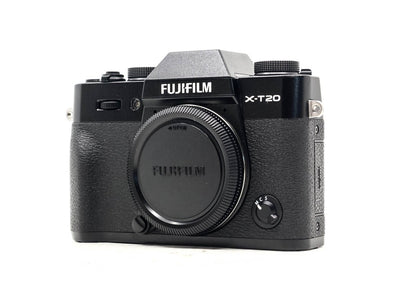
View warranty terms and conditionsThe Fujifilm X-T30 (2019) is a mid-range APS-C mirrorless camera that brought the best of Fujifilm's flagship generation into a small, affordable body. It shares the 26.1MP X-Trans CMOS 4 sensor and X-Processor 4 with the X-T3, so the image quality and JPEG color that made the house famous are here practically intact, but in a chassis of only ~383 g with very pleasant physical dials to use.
It is a camera designed for the enthusiast photographer: travel, street, portrait, and video creators on a budget. It lets you shoot fast bursts, record 4K up to 30p with F-Log and 10-bit output via HDMI, and grow with the entire X-mount lens lineup. At the time, DPReview noted it as one of the best video cameras for its price.
Being honest, it is not a professional action body nor for harsh climates: it has no in-body stabilization (no IBIS), it is not weather-sealed, it has a single SD slot (UHS-I), and it limits 4K to about 10 minutes per clip. Knowing those limits, it remains a very balanced and hard-to-beat value-for-money second-hand purchase.
Read more Read less
The Fujifilm X-T30 is a compact and versatile mirrorless camera, designed to offer an intuitive photographic experience with a focus on image quality and classic style. It is ideal for both advanced enthusiasts and content creators looking for lightweight gear without sacrificing solid performance.
Key Features
- 26.1-megapixel APS-C sensor (X-Trans CMOS 4) with no optical low-pass filter, delivering high sharpness and Fujifilm's characteristic color reproduction.
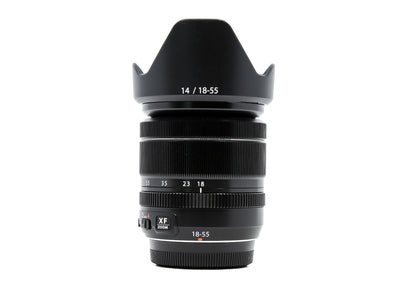
- Fujifilm X mount, compatible with a wide range of XF and XC series lenses.
- 4K video recording at 30 fps and Full HD at 60 fps, with F-Log color profile options and film simulations.
- Launched in 2019, it combines a compact body (approx. 383 g with battery and card) with a high-resolution OLED electronic viewfinder.
Ideal for
Perfect for travel photographers, portraitists, or enthusiasts who value portability and straightforward image quality. Its fast hybrid autofocus system and built-in film simulations make it highly appealing for those seeking a direct creative workflow.
Condition
Second-hand product inspected by Camera Market. Includes standard 6-month warranty and 24-48h shipping from Barcelona.
What lenses are compatible with the Fujifilm X-T30?
It uses the Fujifilm X mount (X-mount), so it is not a fixed-lens camera: it mounts the entire Fujinon XF and XC range and third-party lenses (Viltrox, Sigma, Tamron, Samyang, etc.). Being APS-C, it applies a 1.5x crop factor. You can see the selection at Fujifilm X mount lenses. Since it has no IBIS, for handheld video prioritize lenses with OIS stabilization.
Is it suitable for beginners?
Yes. It is light and compact, with excellent JPEG quality ready to publish and intuitive physical dials. It has automatic modes to start and full manual control to grow. Keep in mind that the screen only tilts (it does not flip forward), so it is not the best option if your main goal is to record yourself.
How is it for video?
Very competent for its class: it records 4K (DCI and UHD) up to 30p with F-Log and 4:2:2 10-bit output via HDMI, and 1080p up to 120 fps for slow motion. Watch out for two limits: in 4K, continuous recording is limited to ~10 minutes per clip due to heat, and it only has a 2.5 mm microphone input (needs an adapter) without a dedicated headphone output.
Does it have in-body stabilization?
No. The X-T30 does not include IBIS, so stabilization depends on the lens. For video or handheld in low light, it is advisable to use lenses with OIS. It is its most relevant limitation compared to models with internal stabilization.
What battery does it use and how long does it last?
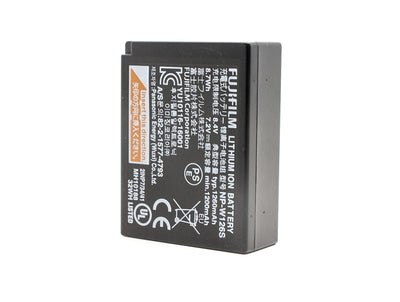
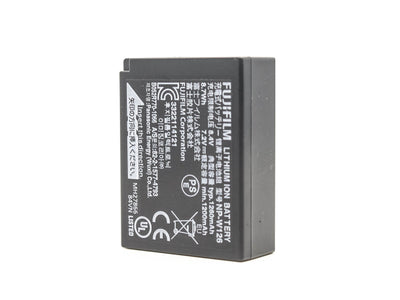
It uses the NP-W126S (Li-ion) and lasts around 380 shots per charge according to CIPA. In real video or burst use, battery life drops considerably, so it is advisable to carry spare batteries. It charges conveniently via USB-C. Verify that the battery is an original NP-W126S and holds up well, as old or cheap clones perform poorly.
Is it reliable bought second-hand and what should I check?
It is a solid and reliable body if you inspect it. First confirm the exact model: X-T30, X-T30 II, or X-T30 III are almost identical externally (check in the menu/serial). Test shots at all speeds listening for abnormal shutter noises, check for dust spots on the sensor (photo of a light wall with a closed aperture), check the touchscreen and LCD tilt, and that the SD slot next to the battery closes properly.
What is the difference between the X-T30 and the X-T30 II?
They share the same base (sensor, processor, and features), but the X-T30 II improves the screen resolution (1.62M dots) and the buffer for longer bursts. The X-T30 III (2025) is the most recent version. As they look very similar externally, confirm which one you are buying via the menu or serial number, not just by the photo.
Full condition scale
Each unit is inspected at 28 points and graded honestly. Here's how we translate each level so you know what to expect:
Barely any signs of use. Almost flawless aesthetics and perfect operation.
Light marks from normal use. Optically clean and fully functional.
Visible signs of use (scuffs, marks, brassing). Works perfectly.
Not guaranteed for use: sold for parts or repair.
Why buy used?
Depreciation is already absorbed: the same gear for much less than new.
Many classics and discontinued gems only exist today on the used market.
28-point inspection and 6-month warranty included on every unit.
Extending the life of a camera avoids manufacturing and transporting a new one.