Got this camera?
Sell it with us.
Free appraisal in 24 h, payment in 48 h and free shipping. We inspect it, refurbish it and give it a second life.
Inspected at 28 points by our technicians. Every unit is unique. More details
Subscribe and save on your order
Get a discount code by email.
Thanks for subscribing.
Use the code at checkout:
CAMERAMARKET10
Protect your purchase for longer.
Your camera ships with 6 months of coverage included. Extend it if you want professional photographer peace of mind.
Units sold for parts do not qualify for extended warranty.
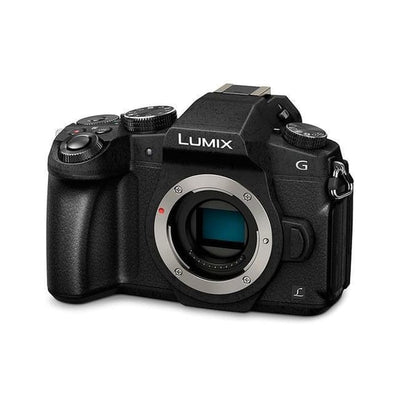
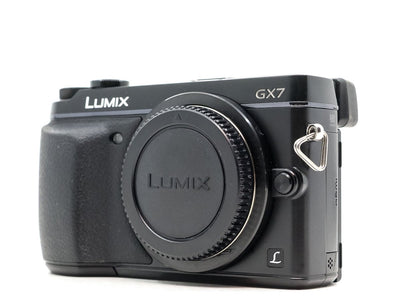
View warranty terms and conditionsThe Panasonic Lumix DMC-GX80 (known as the GX85 in North America and GX7 Mark II in Japan: it is exactly the same body) arrived in June 2016 as a compact mid-to-high-end camera with a rangefinder-style viewfinder mounted in the upper left corner (not central). Panasonic designed it for the street photographer, the traveler, and the advanced enthusiast who wants a small, discreet camera but with serious controls and real stabilization. It inherits a lot from the GX7 and GX8 in a more contained and affordable format.
It mounts a 16 MP Micro Four Thirds sensor from which Panasonic removed the low-pass filter to gain perceived sharpness, and adds two assets that still make it appealing today: 5-axis in-body stabilization (Dual I.S. with compatible lenses), very effective even in video, and a redesigned electromagnetic shutter that drastically reduces (Panasonic claims ~90%) the annoying "shutter shock" of previous models. It records 4K, offers 4K Photo, and its tilting touchscreen is very well executed.
It is honest to acknowledge its limitations: the field-sequential viewfinder causes "color tearing", it has no audio inputs, lacks weather sealing, and its battery life is modest. As a compact, stabilized second-hand camera, it still offers a price-performance ratio that is hard to match.

Read more Read less
The Panasonic Lumix DMC-GX80 is a compact and versatile mirrorless camera, designed to offer an excellent balance between portability and advanced features. It is ideal for both demanding enthusiasts and travelers looking for lightweight gear without compromising image quality.
Key Features
- 16-megapixel Micro Four Thirds sensor, delivering good image quality and performance in low-light conditions.
- Micro Four Thirds mount, compatible with a wide range of interchangeable lenses from Panasonic and Olympus.
- 4K video recording capability, perfect for capturing high-resolution content.
- Launched in 2016, it stands out for its built-in electronic viewfinder and robust, compact design.
Ideal for
Perfect for photographers who want a mirrorless camera with strong video and photo performance, as well as those who value lightness and easy portability on their creative outings.
Condition
Second-hand product inspected by Camera Market. Includes a standard 6-month warranty and 24-48h shipping from Barcelona.
What lenses are compatible with the GX80?
It uses the Micro Four Thirds (M43) mount, so it is not fixed-lens: it accepts the entire catalog of Micro 4/3 mount lenses from Panasonic and Olympus/OM System, as well as third-party ones like Sigma, Sirui, or Laowa, and almost any manual lens with an adapter. Remember that the crop factor is 2x (a 25 mm is equivalent to about 50 mm).
Are the GX80, GX85, and GX7 Mark II different cameras?
No. It is exactly the same body with three names depending on the market: GX80 in Europe, GX85 in North America, and GX7 Mark II in Japan. Any review of the 'GX85' applies equally. It is not a different or worse model.
How is the battery and battery life?
It uses the battery DMW-BLG10 and its CIPA battery life is about 290 shots with the screen (slightly less, about 270, with the viewfinder), a modest figure. For a day of intensive use, it is advisable to carry one or two spare batteries. Note: it charges via USB inside the camera and did not always include an external charger as standard.
Is it good for video?
Yes for general use: it records 4K UHD at 30p/24p and Full HD up to 60p, and the 5-axis stabilization helps a lot handheld. Its limitation for serious video is that it has no microphone or headphone inputs, so audio is left to the internal mic or a separate recorder.
Is it good for someone starting out?
It is a good entry point to the M43 system: compact, with a very intuitive touchscreen and stabilization that forgives shaky hands. It has automatic modes and 4K Photo to not miss the moment. As you learn, you have full manual controls. The learning curve is manageable and the lens system is huge.
Is it reliable bought second-hand?
Yes, it is a well-resolved body and its electromagnetic shutter reduces typical wear. Keep in mind that it is not weather-sealed (no heavy rain or dust) and that the 2016 16 MP sensor is not the best option for very high ISOs or extreme crops. For its size and stabilization, it remains a very sensible purchase.
What should I check when buying it used?
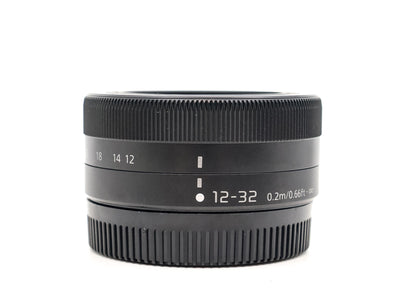
Turn it on and check the viewfinder and touchscreen, look for dust on the sensor (exposed mount) and verify that the stabilization (IBIS) works. Since it charges via USB in the body, make sure it charges properly and that it includes a healthy DMW-BLG10 battery. If it comes with the collapsible 12-32 mm kit lens, check that its mechanism works.
To complete it, take a look at spare batteries, memory cards or camera cases.
Full condition scale
Each unit is inspected at 28 points and graded honestly. Here's how we translate each level so you know what to expect:
Barely any signs of use. Almost flawless aesthetics and perfect operation.
Light marks from normal use. Optically clean and fully functional.
Visible signs of use (scuffs, marks, brassing). Works perfectly.
Not guaranteed for use: sold for parts or repair.
Why buy used?
Depreciation is already absorbed: the same gear for much less than new.
Many classics and discontinued gems only exist today on the used market.
28-point inspection and 6-month warranty included on every unit.
Extending the life of a camera avoids manufacturing and transporting a new one.